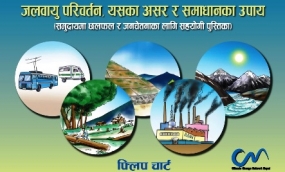
What is Climate Change ?
The trapping of solar heat due to the increasing presence of greenhouse gases (i.e. Carbon Dioxide, Nitrous Oxide, Ozone, and Chloro-fluoro Carbons) in the earth's atmosphere is known as greenhouse effect. This causes global warming, a temperature increasing process, which results in Climate Change.
As a consequence, the world is experiencing changes in weather patterns, rise in sea level and melting of glaciers.
Global Evidences and Impacts of Climate Change
• Usage of fossil fuels (coal, oil and gas) in households, transport and industries is responsible for building up GHGs in the atmosphere.
• The concentration of carbon dioxide in the atmosphere has increased from 280 PPM (pre-industrial value) to 379 PPM (in 2005) i.e. overall 35% increment.
• The concentrations of methane and nitrous oxide have increased by 148% and 18% respectively.
• The global average temperature has increased by 0.74 degrees Celsius during the period of 1906 to 2005.
• Eleven of the last twelve years (1995-2006) rank among the warmest years in the instrumental record of global surface temperature since 1850.
• Even if we take steps now to reduce our emissions of greenhouse gases, the globe could warm up at a rate faster than it has in the past 10,000 years.
• Climate change has widespread implication for agriculture, water resources, biodiversity and forest, human health and livelihood of people.
Nepal's Contribution to Global GHGs Emission
Nepal's total GHGs emission share is negligible and is only 0.025% of total global emission. According to the National Communication Report prepared by the Government of Nepal, net emission of CO2 was about 9.747 tons and the net emission of methane was estimated to be 0.948 tons in 1994.
Climate Change Evidence and Impacts in Nepal
• Average temperature in Nepal is increasing at a rate of approximately 0.06 Degrees Celsius per year between the years 1977 and 1994.
(Source : Department of Hydrology and Meteorology)
• Another temperature analysis from 1976 till 2005 has revealed that the average temperature in Nepal has increased by 0.597 Degrees Celsius.
• The temperature in the Himalayas, however, is increasing at a faster rate, which is having serious impacts on the glaciers and glaciers lakes-the main source of Nepal's water resources.
• According to UNEP, 40 Himalayan glacial lakes are dangerously close to bursting because of the ice melt caused by global warming.
• Water resources, Agriculture, Forestry and biodiversity and Health sectors have been identified as the Nepal's key sectors, which are vulnerable to climate change.
• Unreliable and unpredictable river flow pattern affecting hydroelectricity power plants;
• Enhanced frequency and intensity of flood and droughts;
• Rapid melting of glaciers and snows increasing threat to Glacial lake outburst flood;
• Shrinkage of fresh tower due to rapid melting of glaciers and snow.
• Loss of fertile land due to flood, landslide, soil erosion;
• Introduction of new fungal and bacterial diseases;
• Famine and food scarcity due to regular crop failure.
• Accelerate the rate of species extinction;
• New pests and more forest fire.
• Water borne diseases during disaster events;
• Heat stress and heat wave.
Nepal's Response to Climate Change
In response to Climate Change, Nepal has taken following initiatives:
• Nepal signed the UNFCCC in Rio de Janeiro in June 1992 and ratified it on 2nd May in 19994. Since then, Nepal has been regularly participating in COPs and other subsidiary meetings.• It also became party of Kyoto Protocol by submitting its instrument of Accession on September 16, 2005.
• To take advantage of the Clean Development Mechanism (CDM) as a source of new investment and technology, Nepal is trying to develop various CDM projects which promote clean energy and sustainable development in the country. Nepal has recently set up the National Designated Authority under the Ministry of Environment, Science and Technology to approve CDM projects.
• National Climate Change policy and National Adaptation Programme of Action are being formulated.
• The Alternative Energy Promotion Centre, together with several NGOs and private companies, is promoting clean energy efficiency technologies such as biogas, micro-hydro and solar through subsidies as well as technical assistance.
• In a bid to lower the usage of fossil fuel in the transport sector, Nepal is promoting electric vehicles as a promising alternative. Nepal is ideal for promotion of electric vehicles because they use hydropower, a local and clean resource instead of imported fossil fuel, and the driving conditions (short distances and relatively slow speeds) are suitable for EVs. Kathmandu now has approximately 600 zero-emission electric vehicles and there is potential for a lot more, provided that the government policies are favorable.
• Governments as well as INGOs are regularly working for data and information generation on Climate Change related impacts and for raising awareness among local people.
• Ministry of Environment, Science and Technology has set up Climate Change Network comprising of representatives of relevant government bodies, NGOs, civil society and experts for information and knowledge management and policy input.
Clean Energy Nepal,